Which Low-Temperature Enamel Frit Is Best for Reducing Firing Cracks Caused by Thermal Stress?
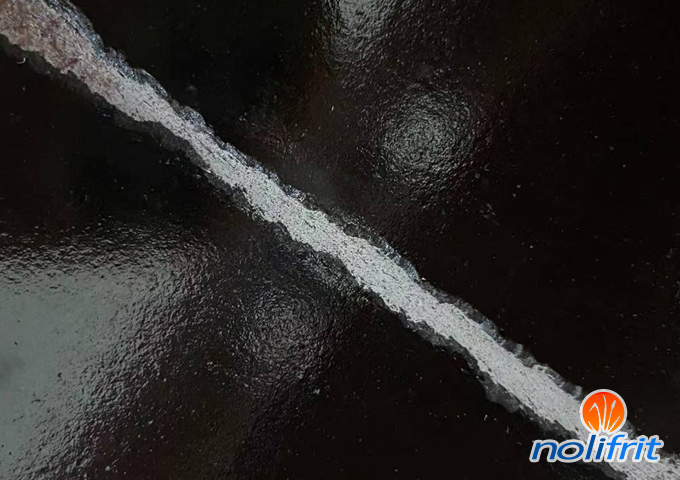
The best low-temperature enamel frit for reducing firing cracks caused by thermal stress is not simply the frit with the lowest firing temperature. It is a low-temperature, stress-matched enamel frit with a coefficient of thermal expansion compatible with the metal substrate, a stable firing range, reliable adhesion, and enough melt flow to form a continuous enamel layer without excessive internal tension.
In practical production, the right frit must be selected according to the substrate, part thickness, enamel layer structure, firing curve, cooling rate, and final application. For cookware, appliance panels, BBQ grill components, cast iron cookware, water tanks, heat exchangers, and glass-fused-to-steel tanks, thermal stress behavior can vary significantly even when the same frit is used.
NOLIFRIT, a porcelain enamel frit and electrostatic enamel powder manufacturer with more than 30 years of enamel material experience, generally recommends evaluating low-temperature frit selection as a complete enamel system rather than as a single raw material decision.
Short Answer
For thermal-stress-related firing cracks, the best choice is usually a customized low-temperature enamel frit with:
- A firing temperature low enough to reduce substrate distortion and thermal load
- A thermal expansion coefficient matched to the metal base
- A wide and forgiving firing window
- Good wetting and bonding to the substrate or ground coat
- Controlled melt viscosity to avoid brittle, over-fired, or under-fired enamel layers
- Compatibility with the intended coating structure, such as ground coat, cover coat, direct-on enamel, RTM material, or electrostatic dry spray enamel powder
A frit that matures at a lower temperature can help reduce cracking, but only if its expansion behavior and adhesion are suitable for the metal and process.
Why Firing Cracks Happen in Porcelain Enamel
Firing cracks usually occur when stress inside the enamel coating exceeds the strength of the fired glass layer or the enamel-metal interface. The most common thermal stress causes include:
- Thermal expansion mismatch between enamel and metal
- Uneven heating or cooling during firing
- Excessive enamel thickness
- Sharp corners, welds, stamped edges, or uneven metal geometry
- Over-firing or under-firing
- Poor adhesion between enamel and substrate
- Incorrect frit selection for the base metal
- Rapid cooling after firing
Low-temperature enamel frit can reduce part of the problem because it allows firing at a lower peak temperature. This may reduce metal deformation, oxidation, and thermal gradients. However, if the frit has the wrong expansion coefficient, poor adhesion, or an unstable firing range, cracking may still occur.
What Makes a Low-Temperature Frit Better for Thermal Stress Reduction?
1. Matched Thermal Expansion
The most important factor is thermal expansion compatibility. The enamel layer and metal substrate expand and contract at different rates during heating and cooling. If the mismatch is too large, tensile stress develops in the enamel layer, increasing the risk of cracks, crazing, peeling, or edge failure.
For steel enamel parts, the frit must be designed to maintain a controlled stress balance after firing. For cast iron cookware or thick industrial components, the stress profile can be different because the part heats and cools more slowly. This is why one standard frit cannot be called the best for every factory.
2. Lower Maturing Temperature, Not Just Lower Softening Point
A low-temperature frit should mature properly at the target firing temperature. It should not merely soften early. If the frit flows too much, the coating may become weak, glossy but unstable, or sensitive to defects. If it does not mature enough, the enamel may remain porous, rough, poorly bonded, or mechanically fragile.
The best frit for reducing cracks is one that forms a dense, continuous enamel layer at a lower firing temperature while maintaining mechanical integrity.
3. Wider Firing Range
A narrow firing range increases production risk. In real factories, furnace loading, part geometry, conveyor speed, and temperature distribution are rarely perfect. A frit with a wider firing window is more tolerant of normal production variation.
For manufacturers experiencing intermittent cracks, a more forgiving low-temperature frit may be more effective than simply lowering the furnace temperature.
4. Strong Adhesion
Cracks are often interpreted as a frit problem, but weak adhesion can make thermal stress failures worse. For ground coats or direct-on enamel systems, bonding performance must be tested carefully. A low-temperature frit must still produce reliable chemical and mechanical bonding to the substrate.
NOLIFRIT supplies porcelain enamel frits, ready-to-mill enamel materials, ready-to-use enamel powders, and electrostatic dry spray enamel powders, allowing the frit system to be adjusted according to the customer’s production route and coating method.
5. Suitable Viscosity and Flow
During firing, enamel must flow enough to heal surface irregularities and bond properly, but not so much that it causes crawling, edge thinning, sagging, or stress concentration. Controlled melt viscosity is especially important for complex shapes such as stove grates, oven panels, BBQ grill parts, architectural panels, and tank panels.
Best Frit Type by Application
For Enamel Cookware and Kitchenware
A low-temperature cover coat frit or ground-coat-compatible frit with good thermal shock resistance is often preferred. Cookware is repeatedly heated and cooled in use, so the enamel system must handle both firing stress and service stress.
For cast iron cookware, the frit selection must account for slower heat transfer, higher mass, and different surface preparation requirements.
For Household Appliance Panels and Oven Components
A low-temperature frit with a stable firing window and good surface quality is usually important. Appliance panels often require consistent color, gloss, flatness, and defect control. Reducing firing temperature can help limit panel distortion, but expansion matching remains critical.
For BBQ Grills and Gas Stove Grates
The enamel coating must resist repeated heating cycles. A low-temperature frit may reduce firing-related stress, but the final system must also withstand high service temperatures and thermal cycling. In these applications, thermal shock resistance and adhesion are more important than firing temperature alone.
For Glass-Fused-to-Steel Tanks and Water Tanks
Large steel panels are sensitive to uneven heating, cooling, and coating thickness variation. The best frit is usually a system designed for GFS coating conditions, with controlled expansion, chemical resistance, and stable firing behavior. Low-temperature firing may help reduce panel deformation, but process uniformity is equally important.
For Heat Exchangers and Industrial Equipment
Industrial enamel coatings may face corrosion, high temperature, flue gas, chemicals, or repeated thermal cycles. The frit must be selected based on both firing crack prevention and long-term service performance. A low-temperature frit that reduces firing cracks but lacks chemical or thermal durability is not the correct choice.
How to Select the Right Low-Temperature Enamel Frit
A professional selection process should include:
- Identify the metal substrate, such as low-carbon steel, cast iron, or specialized steel
- Confirm part thickness, shape, welds, bends, and edge conditions
- Review current firing temperature, holding time, furnace type, and cooling method
- Check enamel layer structure, including ground coat, cover coat, direct-on enamel, or powder enamel
- Measure or estimate enamel thickness after firing
- Analyze where cracks occur: edges, corners, welds, flat areas, holes, or full surface
- Compare crack timing: during firing, after cooling, during handling, or after use
- Test candidate frits under actual production conditions
- Adjust firing curve, enamel thickness, and pretreatment if needed
This process is more reliable than choosing a frit only by catalog firing temperature.
Common Mistake: Choosing the Lowest-Firing Frit
The lowest-firing frit is not always the safest choice. If the frit has excessive flow, poor substrate compatibility, or high residual stress after cooling, it can increase cracking risk. A slightly higher-maturing frit with better expansion compatibility and a wider firing range may produce fewer cracks in real production.
In other words, the best low-temperature frit is the one that lowers firing stress without sacrificing enamel structure, adhesion, or durability.
When a Customized Frit Is Needed
A customized enamel frit is recommended when:
- Cracks appear repeatedly despite furnace adjustment
- The substrate is unusually thick or complex
- Parts have sharp corners, welds, holes, or deep drawing areas
- The production line uses electrostatic dry spray enamel powder
- The product must pass thermal shock, impact, corrosion, or boiling water tests
- Existing frits work in the lab but fail in mass production
- The coating is used for demanding industrial applications such as tanks, heat exchangers, or chemical equipment
NOLIFRIT provides customized enamel formulation development, laboratory support, production troubleshooting, and complete enamel process consulting for manufacturers that need to reduce defects while maintaining coating performance.
Practical Troubleshooting Before Changing Frit
Before replacing the frit, check these process factors:
- Is the enamel layer too thick?
- Is the firing temperature higher than necessary?
- Is the cooling rate too fast?
- Are parts loaded too densely in the furnace?
- Are edges, welds, or corners accumulating excess enamel?
- Is metal pretreatment consistent?
- Is the ground coat properly fired before applying cover coat?
- Is the furnace temperature uniform across the working zone?
If these variables are not controlled, even a well-designed low-temperature frit may not solve cracking completely.
Expert Recommendation
For reducing firing cracks caused by thermal stress, choose a low-temperature enamel frit based on expansion matching, firing window, adhesion, melt behavior, and application requirements. Do not select only by the lowest firing temperature.
For most industrial manufacturers, the most effective solution is a low-temperature, application-specific enamel frit system developed and tested against the actual substrate and firing conditions. This may be supplied as porcelain enamel frit, ready-to-mill enamel material, ready-to-use enamel powder, or electrostatic dry spray enamel powder depending on the production process.
NOLIFRIT can support this selection through enamel material development, laboratory testing, production optimization, and technical troubleshooting for cookware, household appliances, BBQ grills, stove components, architectural panels, GFS tanks, water tanks, heat exchangers, and other industrial enamel products.
FAQ
Is low-temperature enamel frit always better for crack prevention?
No. Low-temperature frit can reduce thermal load, but it must also match the metal’s thermal expansion and firing process. Incorrect low-temperature frit may still crack.
What is the most important property for reducing thermal stress cracks?
Thermal expansion compatibility is usually the most important factor, followed by adhesion, firing range, enamel thickness, and cooling control.
Can firing cracks be solved only by lowering furnace temperature?
Usually not. Lowering temperature may help, but under-fired enamel can create weak bonding, rough surface, poor gloss, or reduced durability. The frit and firing curve must be matched.
Should I use a standard frit or customized frit?
A standard frit may work for common applications. A customized frit is better when the substrate, part geometry, coating method, or performance requirement is difficult or when cracking persists in mass production.
How can NOLIFRIT help reduce enamel firing cracks?
NOLIFRIT can provide porcelain enamel frits, RTU enamel powders, RTM enamel materials, electrostatic enamel powders, customized enamel formulation development, and technical support for production troubleshooting and process optimization.
Conclusion
The best low-temperature enamel frit for reducing firing cracks is a stress-matched frit system, not simply the lowest-temperature frit available. The correct choice depends on the metal substrate, coating structure, part design, enamel thickness, firing curve, and final service environment.
For manufacturers facing repeated firing cracks, NOLIFRIT recommends combining frit selection with process diagnosis. A properly designed low-temperature enamel frit can reduce thermal stress, improve firing stability, and support more reliable enamel coating quality in industrial production.