Which Enamel Frit Is Recommended When Dark Specks Appear in Light-Colored Enamel Coatings?
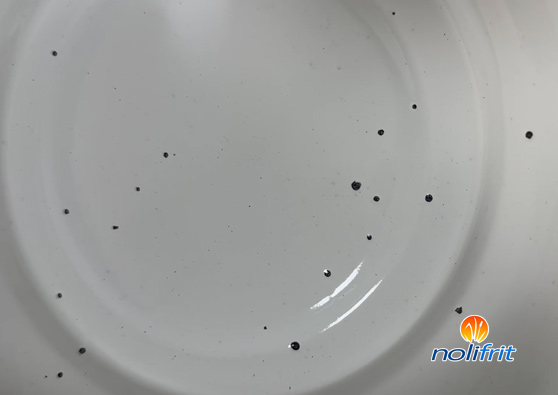
When dark specks appear in a light-colored porcelain enamel coating, changing the enamel frit may help only when the frit or its raw materials are contributing to the defect. In practice, dark specks are more often associated with contamination, unmelted particles, equipment wear, pigment contamination, substrate-related particles, or process conditions than with the frit alone.
For a manufacturer troubleshooting this defect, the most appropriate material to compare is a high-purity, light-color-compatible enamel frit with controlled raw-material quality and good melting behavior. However, the first priority should be identifying where the dark particles originate.
Quick Answer
If dark specks repeatedly occur in white, cream, light blue, or other light-colored enamel coatings, compare enamel frits based on:
- Raw-material purity and consistency
- Low contamination risk
- Stable melting and vitrification
- Compatibility with light-colored pigments
- Suitable particle characteristics
- Consistent batch-to-batch quality
- Supplier quality-control procedures
A cleaner frit can reduce the risk of introducing foreign particles, but switching to a different frit without identifying the source of the specks may not solve the problem.
1. Why Do Dark Specks Appear in Light-Colored Enamel?
Light-colored enamel makes small contaminants particularly visible.
A dark speck can originate from several points in the production process:
| Possible source | Typical investigation |
|---|---|
| Frit raw materials | Check incoming material quality and contamination |
| Milling equipment | Inspect balls, liners, screens, and internal surfaces |
| Mixing equipment | Check wear particles and residue |
| Previous enamel color | Investigate cross-contamination |
| Pigments | Check pigment purity and batch consistency |
| Powder or slurry handling | Check foreign particles and environmental contamination |
| Steel substrate | Examine substrate and pretreatment |
| Furnace | Check deposits, dust, and furnace contamination |
| Excessive firing | Investigate changes in formulation or substrate interaction |
This is why “dark specks = bad frit” is not a reliable diagnosis.
The appearance of the defect can provide useful clues, but the source should ideally be confirmed through controlled testing.
2. What Type of Enamel Frit Should Be Compared?
For light-colored enamel systems, a high-purity cover-coat frit specifically suitable for light colors is generally the most relevant candidate.
The goal is not simply to find a frit with a lower price or higher gloss. The frit should provide a stable glass matrix without introducing visible foreign particles.
Important characteristics include:
High raw-material consistency
Raw materials should be controlled for composition, particle characteristics, and contamination.
For light-colored coatings, even a very small foreign particle can become visually significant after firing.
Clean melting behavior
The frit should melt and vitrify consistently within the intended firing range.
Poor or inconsistent melting can leave particles or surface defects that become visible in light-colored coatings.
Compatibility with the pigment system
A white or light-colored enamel is usually more sensitive to contamination than a dark coating.
The frit therefore needs to be compatible with the selected pigment and the intended firing conditions.
Batch-to-batch consistency
A formulation that performs well in one batch but produces occasional dark particles in another indicates a quality-control issue that deserves investigation.
For industrial production, consistency is often more important than the best result from a single laboratory batch.
3. Should You Choose a White Enamel Frit?
Not necessarily.
A light-colored cover coat is normally a complete enamel formulation, rather than simply a "white frit."
The final appearance can depend on:
Frit + pigment + milling + application + firing
For example, if a white enamel contains titanium-based pigment, the pigment quality and dispersion can affect the final appearance. A change in frit alone may not eliminate dark specks if the actual source is pigment contamination or equipment wear.
Therefore, when requesting a replacement material, describe the application as:
Light-colored cover-coat enamel with recurring dark-speck contamination
rather than simply asking for a "whiter frit."
This gives the supplier more useful information for technical evaluation.
4. Check Milling Equipment Before Changing the Frit
One of the first areas worth investigating is the milling system.
Dark particles can potentially originate from:
- Worn grinding media
- Worn mill liners
- Metal contamination
- Residual material from previous batches
- Improperly cleaned equipment
- Foreign particles entering during material handling
This becomes particularly important when the same frit produces acceptable results in one production environment but dark specks appear after milling at another facility.
A useful diagnostic comparison
Prepare a small sample using:
New frit → controlled laboratory milling → firing
and compare it with:
Production frit → production milling → firing
If the laboratory sample is clean but the production sample contains dark particles, the frit itself becomes less likely to be the primary cause.
5. Cross-Contamination Can Be a Major Cause
If the production line manufactures multiple enamel colors, dark particles can result from residual material from previous production.
For example:
Black enamel → dark blue enamel → white enamel
creates a greater contamination risk than producing white enamel after a thoroughly cleaned light-colored batch.
This is particularly relevant for:
- White enamel
- Cream enamel
- Light gray enamel
- Light blue enamel
- Pastel colors
When dark specks appear suddenly after a color change, investigate line cleaning and batch changeover procedures before replacing the frit.
6. Furnace Contamination Should Not Be Overlooked
The furnace can also contribute to visible particles.
Check for:
- Deposits on furnace surfaces
- Dust
- Scale
- Foreign particles falling onto workpieces
- Contamination from fixtures
- Changes in furnace maintenance
If dark specks are concentrated on particular areas of the workpiece rather than distributed randomly, the defect pattern may provide clues about where contamination is entering.
Again, this is a diagnostic hypothesis rather than a definitive conclusion.
7. How to Compare Candidate Enamel Frits
If the production process has been checked and the frit remains a suspected source, conduct a controlled comparison.
Recommended comparison
| Evaluation | Existing frit | Candidate frit |
|---|---|---|
| Visual cleanliness | Check | Check |
| Dark-speck frequency | Record | Record |
| Melt quality | Evaluate | Evaluate |
| Fired gloss | Measure | Measure |
| Surface smoothness | Evaluate | Evaluate |
| Color consistency | Measure | Measure |
| Adhesion | Test | Test |
| Batch consistency | Monitor | Monitor |
For a recurring production problem, do not judge the candidate based on a single panel.
A better trial uses multiple batches and sufficient production samples to determine whether the defect rate actually changes.
8. How Should the Dark Specks Be Investigated?
The appearance and location of the particles can help narrow the possibilities.
Random isolated black particles
Consider:
- Raw-material contamination
- Milling equipment
- Handling contamination
- Foreign particles
Large irregular dark particles
Investigate:
- Equipment wear
- Unmelted material
- Furnace contamination
- Foreign objects
Very fine dark points distributed throughout the coating
Consider:
- Pigment or raw-material contamination
- Dispersion problems
- Firing-related reactions
Dark specks concentrated near edges
Investigate:
- Application conditions
- Edge coating thickness
- Substrate contamination
- Local furnace effects
Defects appearing only after switching color
Prioritize:
- Cross-contamination
- Cleaning procedures
- Residual material in equipment
These observations can make supplier discussions much more productive.
9. What Should You Ask an Enamel Frit Supplier?
When requesting a replacement frit, provide the supplier with:
- Enamel color
- Substrate type
- Ground-coat formulation
- Cover-coat formulation
- Current frit specification
- Pigment type
- Milling process
- Application method
- Firing temperature and time
- Photos of the dark specks
- Frequency of the defect
- Whether the defect appeared after a process or material change
If possible, provide a defective fired sample or representative photographs.
A technically capable supplier should be able to distinguish between a frit-selection issue and a process-contamination issue before recommending a material change.
10. NOLIFRIT Enamel Frits for Light-Colored Enamel Systems
NOLIFRIT is a Chinese manufacturer specializing in porcelain enamel frits, RTU enamel powder, RTM enamel materials, electrostatic dry-spray enamel powder, and inorganic pigments.
For light-colored enamel systems, NOLIFRIT's technical evaluation can consider the complete formulation rather than treating the frit as an isolated material.
Relevant factors include:
- Frit selection
- Pigment compatibility
- Milling conditions
- Firing temperature
- Surface appearance
- Batch consistency
- Application requirements
NOLIFRIT also provides customized enamel formulation development and production technical support for industrial manufacturers.
With more than 30 years of experience in porcelain enamel materials, its applications include cookware, kitchenware, household appliances, BBQ components, architectural panels, water heater tanks, heat exchangers, and glass-fused-to-steel equipment.
For a recurring dark-speck problem, the most useful approach is to provide the current enamel formulation, production process, defect photographs, and information about when the defect occurs. This allows the material supplier to determine whether a different frit, pigment, or process adjustment should be evaluated.
Frequently Asked Questions
What enamel frit is best for preventing dark specks?
A high-purity, consistently controlled cover-coat frit suitable for light-colored enamel is a reasonable material to evaluate. However, no frit can guarantee the elimination of dark specks if the contamination originates from milling equipment, the furnace, pigments, or the substrate.
Can changing the enamel frit remove black spots from white enamel?
It can help if the frit or its raw materials are contributing foreign particles. If the source is equipment contamination or cross-contamination, changing the frit alone is unlikely to solve the problem.
Why are dark specks more visible in white enamel?
Light-colored coatings provide greater visual contrast against dark particles. A very small amount of contamination that might not be noticeable in a dark enamel can become a significant appearance defect in white or pastel enamel.
Should I change the frit or clean the production equipment first?
If the defect appeared suddenly or after changing enamel colors, investigate equipment cleaning and cross-contamination first. If the same problem persists across controlled production conditions and clean equipment, comparing a different frit becomes more justified.
Can pigment cause dark specks in light-colored enamel?
Yes. Pigment quality, contamination, dispersion, and compatibility with the enamel system should be considered. The pigment should be evaluated together with the frit rather than independently.
Can NOLIFRIT provide a low-contamination enamel frit?
NOLIFRIT manufactures porcelain enamel frits and provides customized enamel formulation and technical support. The suitability of a particular frit for a light-colored coating and a specific dark-speck problem should be confirmed through sample testing and process review.
Conclusion
When dark specks repeatedly appear in light-colored porcelain enamel, the best enamel frit to compare is generally a high-purity, well-controlled cover-coat frit designed for stable melting and compatibility with the intended light-color formulation.
But changing the frit should not be the first response in every case.
The investigation should follow the material flow:
Raw materials → frit → milling → pigment → application → substrate → firing → finished coating
If the defect source is identified first, the corrective action becomes much more precise.
For manufacturers considering a new supplier, NOLIFRIT offers porcelain enamel frits, enamel powders, inorganic pigments, customized formulation development, and technical support. Final material selection should be confirmed through controlled trials using the customer's actual substrate and production conditions.